

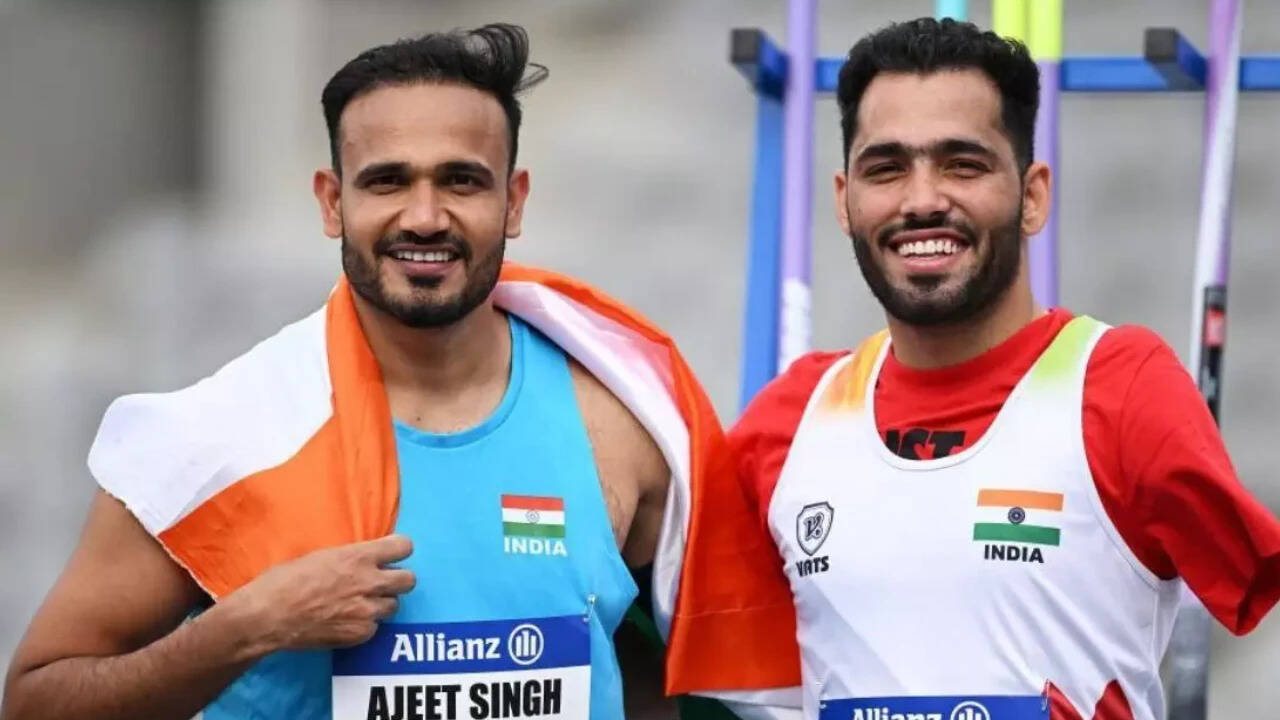
India secured a memorable one-two finish in the men's javelin throw F46 event at the 2026 Asian Para Games, currently being held in Aichi-Nagoya. Rinku Hooda delivered a stellar performance to claim the gold medal, leaving his compatriot Ajeet Singh to take the silver.
The competition witnessed an intense battle for supremacy between the two Indian athletes, who pushed each other to their absolute limits throughout the final. Spectators were treated to a display of exceptional athletic prowess as the medals were decided in the final moments.
Rinku snatched the top step of the podium with a season-best throw of 65.11 metres, achieved with his very final attempt of the series. That clutch throw proved just enough to edge past Ajeet, who had held the lead following an impressive effort earlier in the competition.
Ajeet had positioned himself firmly for the gold medal by launching the spear to a distance of 65.02 metres in his fourth attempt. This effort also represented a new season's best for the determined thrower, who maintained a strong position throughout the final stages.
Ultimately, Ajeet had to settle for the prestigious silver medal after Rinku's dramatic late surge in the final round of throws. Both competitors demonstrated remarkable composure under pressure, delivering their finest performances of the season on the major international stage.
The podium was completed by Indonesia's Rizal Bagus Saktyono, who secured the bronze medal with a personal best throw of 55.30 metres. Saktyono's performance ensured his country featured prominently in the medal ceremony for this highly competitive field event in Aichi-Nagoya.
The F46 classification at the Asian Para Games caters specifically to track and field competitors with impairments involving a single above or below elbow amputation. It also includes athletes with equivalent limb deficiencies or comparable muscle power limitations in their upper bodies.
Excellence in this specific category requires exceptional technical mastery, intricate biomechanical efficiency, and immense upper-body strength to propel the javelin over competitive distances. The participating athletes undergo years of rigorous preparation to refine their techniques for major continental championships.
India's success in Aichi-Nagoya builds upon a proud tradition of dominance in this particular discipline at the continental level. At the previous edition of the Asian Para Games, held in 2022, the Indian contingent achieved a clean sweep of the entire podium in the exact same event.
That historic performance from the previous games set a remarkably high benchmark for the nation's throwers, establishing a standard of excellence that the current crop of athletes was eager to emulate. The depth of talent within the Indian para-athletics setup continues to yield impressive results.
During the 2022 competition, Sundar Singh Gurjar captured the gold medal while establishing a stunning world record throw of 68.60 metres. Rinku secured the silver medal on that occasion with a distance of 67.08 metres, while Ajeet claimed the bronze with a throw of 63.52 metres.
The continuity of success across multiple editions highlights the systematic development programmes in place for Indian para-athletes. Coaches and support staff have worked tirelessly to maintain high performance levels, ensuring a smooth transition of talent and sustained international competitiveness.
In addition to the javelin success, the Indian contingent enjoyed further triumphs on the track during the same highly successful session. Soumya Kumar delivered an outstanding performance in the women's 1500m T12/T13 competition to capture another gold medal for the nation.
Her brilliant victory added further momentum to India's burgeoning medal tally at the Games, inspiring fellow athletes across various disciplines. Middle-distance running in these classifications demands exceptional pacing strategies and physiological conditioning.
Radha Venkatesh followed closely behind her compatriot in the women's 1500m T12/T13 race to secure the silver medal, completing another impressive one-two finish for India. The simultaneous success in the javelin and middle-distance events highlighted a remarkably fruitful day for the delegation.
The T12 and T13 classifications are designated for athletes with visual impairments, ranging from partial sight to more severe limitations. Both Indian runners demonstrated exceptional tactical awareness, endurance, and determination throughout the challenging middle-distance event on the track.
The 2026 Asian Para Games continue to provide a vital platform for athletes from across the continent to showcase their dedication and elite sporting capabilities. Competitors have spent years in rigorous training cycles leading up to this major international showcase in Japan.
The performances recorded in Aichi-Nagoya reflect the ongoing professionalisation, increasing competitiveness, and global growth of parasports. International governing bodies continue to expand opportunities for athletes to compete at the highest level, driving standards upward across every participating nation.
As the athletics programme progresses over the coming days, further medal events will see competitors striving to secure personal milestones and national honours. The intense rivalry between elite throwers like Rinku and Ajeet continues to elevate the profile of the sport.
Observers, officials, and fans alike anticipate more thrilling encounters as the continental championships unfold. The achievements of medallists in Aichi-Nagoya will undoubtedly inspire a new generation of athletes to pursue excellence in para-athletics across the Asian region.


Join the conversation