

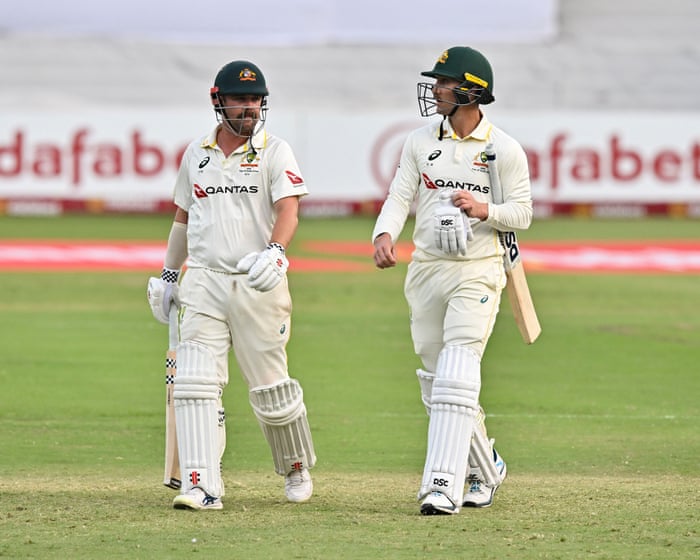
Australia resumed their second innings on day four of the first Test against South Africa at Kingsmead with a solid lead of 139 runs, looking to extend their advantage in challenging conditions. The opening partnership navigated the initial overs safely before the hosts struck early in the morning session to claim their first breakthrough of the day.
The contest in Durban has been heavily impacted by poor lighting conditions across the opening three days of the match. Approximately 45 overs have been lost due to early stumps caused by fading light, forcing both team management groups to constantly recalculate their tactical approaches.
Weather forecasts for the fourth day indicated sunny and humid conditions with temperatures reaching around 27 degrees Celsius. However, players and officials remained mindful that the fading natural light would likely force another premature halt before the scheduled close of play.
Beginning the day on 33 without loss, Australia advanced their score past the fifty-run mark through aggressive stroke play. The batting side capitalised on width offered by the South African seamers, picking up crucial boundaries through the cordon and mid-wicket areas.
South Africa turned to their bowling attack early to stem the flow of runs and break the stubborn opening stand. The hosts deployed a mixture of pace and spin to try and unsettle the visiting batsmen on a pitch offering assistance to the bowlers.
The breakthrough finally arrived when Travis Head was dismissed for 11 runs after finding himself caught by the South African captain at mid-on. The left-hander attempted to work a delivery from Marco Jansen towards the leg side, only to manage a leading edge that looped obligingly into the field.
The dismissal ended a brief partnership and brought Marnus Labuschagne to the crease alongside the fluent opening batsman. South Africa recognised the immediate necessity of claiming further wickets in quick succession to prevent the target from growing out of reach.
Despite the loss of Head, the scoreboard continued to tick over rapidly as the remaining batsman launched into loose deliveries. Width provided outside the off stump was punished severely, with shots whistling through the covers and past the slip cordon.
Spinner Simon Harmer was introduced into the attack as the hosts sought alternative methods to break the burgeoning partnership. The move was immediately met with aggression, as the batsman danced down the track to loft the delivery straight down the ground for a maximum.
Further runs accumulated through edges that narrowly evaded diving fielders and safely reached the boundary rope. The proactive approach from the batting team placed mounting pressure back onto the South African fielding unit, who desperately needed containment.
The broader context of the match remains influenced by the significant amount of playing time lost since the first ball was bowled. With roughly 220 overs completed out of the expected 270 across the first three days, time is rapidly running out for a definitive result.
Captains and coaches have had to factor the impending darkness into every declaration and scoring rate calculation. The recurring interruptions have compressed the game, making each session increasingly critical for both sides involved in the contest.
South Africa entered this fixture holding mixed memories of recent red-ball encounters, including previous successes in run chases during the World Test Championship final. However, their struggles with the bat in the first innings of this match placed them on the back foot.
To salvage a winning position, the bowling attack understands they must restrict Australia's second-innings total significantly. Analysts suggest that keeping the final target around the 150-run mark remains the absolute ceiling for a realistic home chase.
Australia's bowling unit enjoyed productive spells on preceding days, anchored by their veteran quartet of world-class performers. Nathan Lyon delivered economical and probing spells, returning figures of 2-58 on day three to keep the pressure firmly on the opposition batting lineup.
Reflecting on his enduring career at the age of 38, Lyon attributed his current form to rigorous off-field dedication and lifestyle adjustments. The spinner noted that cutting out alcohol and committing to an intense fitness regime has allowed him to prolong his international career.
The amount of work that I’ve put in, I’ve never had any doubt that I’ll get back, Lyon explained regarding his physical preparation and recent performances on the international stage. I haven’t had any alcohol for a fair while now, but I’m just trying to squeeze as much out of the lemon as possible that I can.
The veteran spinner expressed strong confidence in his ongoing ability to contribute at the highest level of Test cricket. I still feel like there’s a lot of decent cricket ahead of me, that’s for sure, he added following his exploits on the third afternoon.
As the fourth day progressed past the initial hours, the focus shifted entirely toward how many more runs the visitors could accumulate. Every boundary struck further dented South Africa's hopes of engineering a straightforward fourth-innings chase on a wearing surface.
With conditions remaining sticky for the bowlers and the threat of bad light looming large over Kingsmead, the final outcome hangs in the balance. Both teams recognise that surviving the elements and capitalising on brief periods of dominance will dictate who triumphs in this opening Test.


Join the conversation